“Henry F. Farny, who died Saturday night, was usually described as an Indian painter. The description was neither correct nor fair to Farny. He was a painter of the West, his landscapes of mountain and river and cloud were the justification for his fame. With Remington, horses and Indians were prime consideration; with Farny they were only incidental to a great object. Farny saw the poetry of the West and put it in his pictures. That is why they, and he, were so successful. Cincinnati will be the poorer for Farny’s death. He was not only a notable painter; he was also a man of tremendously vivid personality. And for his strongly marked individuality, he had a fine strain of broad human kindliness. It was a real privilege to be able to number Farny among one’s friends. (Editor of the Cincinnati Times-Star, Dec 26, 1916).
This non-profit site is a work-in-progress. Currently, its goal is to showcase the wide variety of art created by Artist Henry Farny, 1847-1916, focusing mostly on his drawings, which thus far are rarely discussed in biographies and shows about him. There are just over 1,000 Farny drawings on this site, found in books, magazines, newspapers, and other sources. The goal has been to trace them back to their original sources. In a number of cases, the original paintings have been found and linked to the books or magazines in which they appear.
To see a full overview of posts ordered by year, view this page.
Farny’s Life as an Illustrator:
Farny’s illustrations are important, as he learned the hard way upon his return from Europe in 1870 at age 23 that Cincinnatians didn’t want to buy his paintings and, in fact, they weren’t that interested in buying others’ paintings either. Despite the city’s prominence and education and its status as a publishing powerhouse, equal to New York or Boston, the pocketbooks were kept tight in Cincinnati. Many artists eventually moved from Cincinnati to the East Coast for just that reason and forged successful careers. Farny however, had his mother, sisters, and aunt in Cincinnati; he was the last male left of their immediate clan, as he’d lost two brothers and his father; he felt he had to stay.
So, instead of leaving, Farny adapted to the situation by becoming a full-time illustrator. Not only did it ‘pay the bills’, but it also provided him with some unique travel opportunities, experiences and connections he might not otherwise have had. He seems to have remained a full-time illustrator into the mid 1880s.
The success of his painting The Captive in late 1885 helped launch his transition from illustrator to painter, as interest in his paintings soared after he won the New York Water Color Exhibition. A few years later, his move across the river to Covington, permanently in 1890, allowed him to devote more time to painting, uninterrupted by “bores”. For example, in the years 1886-1889 I have documented 14 paintings by Farny. In 1890 alone he did 14 paintings and the number jumped to 20 in 1891.
Another Website Goal –The Book:
An ancillary goal of this website is for me to use it as a series of small writing projects to help form my understanding of Farny for a new book about him. My hope is to correct some of the misinformation about him that persists, across the web, in books, and in museums. He was simply more than a painter of Indians.
Yet, despite the research, the books and the biographies written of him that cover his life and passion for Indians, there is too much that is incorrect and too much undocumented. For example, nearly every biography indicates his first visit west was in 1881, when in fact his visit west was in 1877. We can also document his first Indian-inspired painting, one done in late 1877, though it was more “study” than a final piece. You can learn more about that 1877 “graves” painting and its derivative works here.
Another story that has been unexplored was a journey he took two years later. Farny joined three friends for a canoe trip down the Alleghany River in 1879, though he only floated from Olean, New York, to Warren, Pennsylvania. Thanks to Farny’s friend Nicholas Longworth, we have a good accounting of that portion of the trip. At one point, while camping along the river, a couple of the local Indians met them in their tent, where Farny became smitten with one young lady named Eliza.
Of course, he did go to Fort Yates to visit the Sioux in October of 1881 on a well-documented trip, shooting 124 photos, and hoping, but failing, to meet Sitting Bull. One month prior to the Fort Yates trip, Farny may also may have visited the Zuni reservation along the Arizona/New Mexico border, as several newspaper articles mentioned he was prepared to leave; while there is circumstantial evidence he may have made it, there is no hard proof. That said, in the Summer of 1882, he went to Washington, D.C., and happened to meet six Zuni leaders who had been traveling for several months. He spent two weeks with them.
One underwritten event in Farny’s life was his travels in 1883 with the Villard Northern Pacific Last Spike Procession, a favorite memory of his for reasons that will be explained in the book, which took him to a number of cities in the Pacific Northwest and as far northwest as Victoria, British Columbia. This was a one-of-a-kind, extraordinary, all-expenses-paid trip for more than 300 people from Germany, the UK, and eastern journalists. Farny was just one of two artists on the trip.
In 1884, Farny and Eugene V. Smalley, both working on behalf of Century Magazine, floated the Missouri for roughly 100 miles, a trip that lasted six days (Stubbs Ferry to Fort Benton, Montana); many biographies report the trip as a 1,000 mile canoe trip down the Missouri in 1878, but the distance, the year, and the “canoe” portion of the story is false. After the Missouri trip, Farny also traveled to Colorado for about a week, before returning to Cincinnati.
There were other trips west, the last documented one being in 1896, but I do have some evidence that hints at one more to the Southwest after that, but more info is needed to confirm that one. For all his love of the West, he actually spent quite a bit of time traveling to western Pennsylvania and New York, though his paintings rarely reflected those journeys.
One of the reasons there is misinformation about Farny is that Farny doesn’t appear to have kept a journal or record his own story. He did keep some sketch books, but I only know of a couple and they are in private hands. Moreover, an inaccurate, full-page obituary dated January 21, 1917, in the Cincinnati Commercial Tribune has been oft quoted, information that is still misquoted today in museums, to the demise of Farny’s legacy.
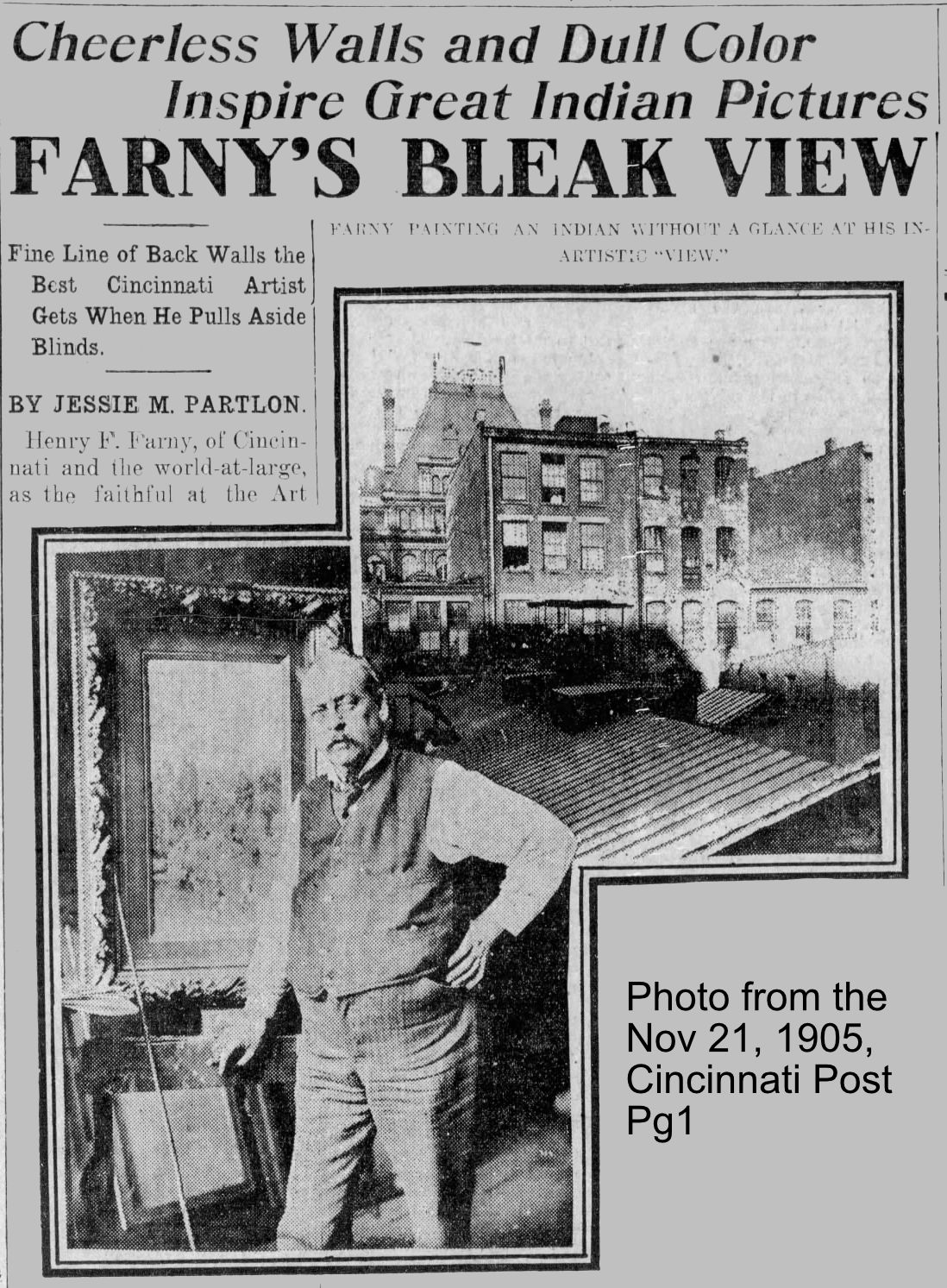
A New Farny Biography:
My decision to write a book on Farny came about in January of 2025 after I was contacted my Supermouche,fr productions in the course of them making a documentary about Henry Farny. They contacted me because I am relative of his (he’s my great great grandmother Leonie Wurlitzer’s brother) and because years ago I had made a contact in Farny’s hometown of Ribeauville, France.
Once I began doing some research on Farny, reviewing many biographies and books, I realized the errors that had been made. So, I began pouring over source documents. Over the past nine months I have reviewed more than 2000 pages of newspapers over six decades. I’ve also transcribed and translated letters from Farny, both in English and French, that provided more insights into his time in Europe between 1867-1870 and in 1873.
Beyond just correcting dates and erroneous statements, expanding his bio beyond his Indian paintings felt important, as he was heavily involved in the rise of the Cincinnati art world, which was a unique bit of American history in the latter half of the 1800s. This is a little told part of his life that deserves more exposure.
Even the number of paintings he’s done has not been estimated, at least there have been no numbers I have seen. Based on my research, I have documented over 680 paintings Farny completed using sources like period newspapers, magazines, library digital archives, auction sites, magazines, and books, catalogs, family members and other media. My hope is to add the list with links and pictures, when I have them, to help folks have a more complete picture of his body of work.
My Fourth Book:
This will be my fourth book and a companion piece to my previous book, SLAG & The Golden Age of Lead-Silver Ore, which was about another part of my family, the Eilers’ side. There are cross-overs between the two, for sure, but SLAG was about mining and smelting and the evolution of the west. It emphasized the cascading boom and busts of western mining over the latter half of the 1800s, while this book will involve art’s interplay with the west and the shift of the West from Cincinnati as a western edge to it becoming more and more easterly, along with the shift from a truly Wild West to a nostalgic West. That said, the book will evolve as I learn more.
If you are a relative of Henry Farny and have letters, illustrations or other things from him to discuss or share, feel free to contact me at d@deilers.com. My father’s cousins and descendants were incredibly helpful in my quest to find information for the first book and other descendants of the Farny, Wurlitzer, Eilers and Strobel lines have proven as equally helpful on this new journey.
Thanks, David Eilers
Prosser, WA
PS: I have thirty years experience building websites, with my “opus” being eWillys.com (now under a new owner who has made some style changes), a site I authored for 18 years that contains 65,000 posts, or an average of 10 uploads every single day, which seems about right.
I also operate Emmaeilers.com, a little website dedicated to my great Aunt Emma Eilers’ art: https://emmaeilers.com.
You can learn more about me at my website: https://www.deilers.com.
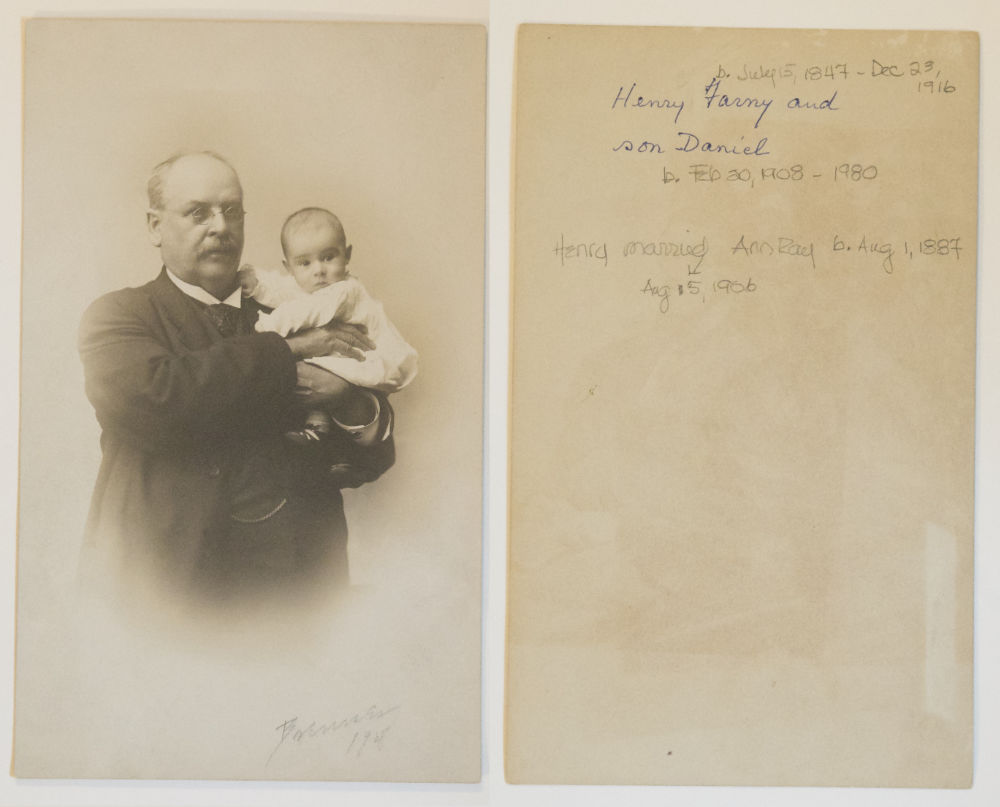
Born June 21, 1930 in New York City, Jean Eilers grew up in Great Neck, New York, the daughter of the late F. Farny Eilers and Lucile Hopkins Eilers. She became Jean Eilers Ratcliffe when she married George Ratcliffe. https://lawrencefuneralhome.com/tribute/details/1609/Jean-Ratcliffe/obituary.html & https://lawrencefuneralhome.com/tribute/details/2920/George-Ratcliffe/obituary.html. The image of Henry and Daniel was one of many that George shared with us, that Jean had inherited, during our visit in 2013.